When I work on a dog’s herding or chasing behavior, my goal is for whatever triggers that behavior to become like leaves moving in the trees: something in the background that the dog doesn’t need to pay attention to.
That is different from teaching a dog to spot a car and then expect an exciting game, an exciting food delivery, or a correction. I want the car itself to become unimportant.
The foundation is to first establish reinforcement that has a calming effect, then introduce the trigger at an intensity the dog can comfortably handle. From there, we can gradually build toward more challenging situations.
Key Takeaways
- Establish food as calming before using it to address herding or chasing triggers.
- Introduce small, manageable versions of the trigger and build difficulty gradually.
- Judge readiness by the dog’s ability to disengage, respond, and calmly search for food.
- Reduce rehearsal between sessions and develop exciting toy play separately from trigger training.
What Does the Trigger Predict?
Food is not automatically calming just because we are using it as positive reinforcement. Some dogs become very excited about treats. If a dog sees a car, squirrel, or another animal and then something highly exciting happens, that trigger can start to predict excitement.
The same concern applies to playing with a toy immediately after the trigger appears. The dog may begin anticipating an exciting event whenever that particular thing comes into view.
This is also one reason I don’t use punishment for this work. A startle or pain can create an arousing event, too. Whether the experience is pleasant or unpleasant, pairing the trigger with heightened arousal works against my goal of helping the dog feel calm and eventually ignore it.
Instead of simply asking, “What reward should I use?” I ask, “How does my dog feel when I use this reinforcer?” For broader background on reward-based training, the American Veterinary Society of Animal Behavior’s position statements are a useful reference.
First, Help Food Become Calming
My Border Collie Wish is a good example of why this preparation matters. When she first came home as a puppy, food did not have a calming effect on her. If I didn’t deliver the next piece immediately, she would bark, whine, and seem frustrated. She also took food hard.
Before using food to work on her response to cars, I spent time changing that experience.
- I made sure she had eaten a meal before training, so she wasn’t hungry.
- I kept food available around the house for reinforcing calm behavior.
- Whenever she settled quietly, I would get a piece of food and drop it between her paws.
I did this for three days. She began settling frequently, even when we had guests over, and food started to have a calming rather than an exciting effect.
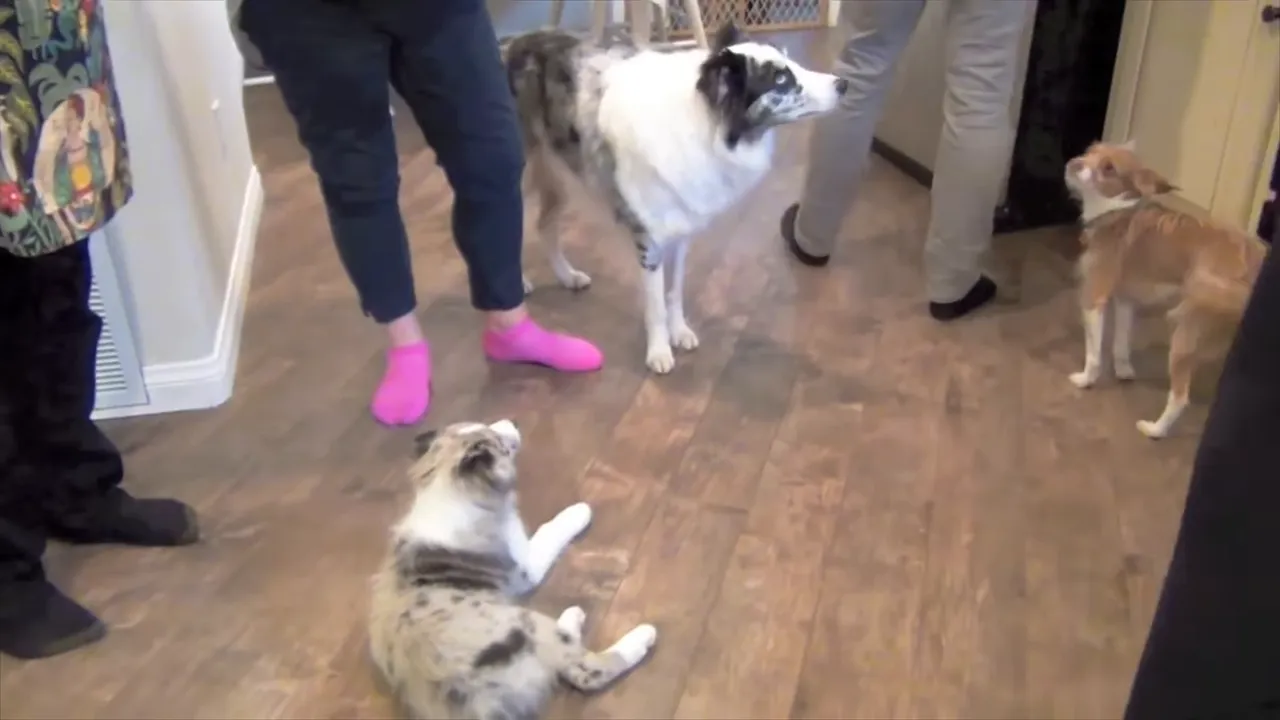
That was Wish’s experience, not a deadline for every dog. The important part is the change in the dog’s response to food, rather than the number of days spent practicing.
Even once food has that calming effect, it cannot be expected to produce calmness in a situation that is already overwhelmingly exciting. The next step is to make the situation easier.
Break the Chasing Trigger Into Manageable Pieces
A dog who wants to chase a moving car may be able to remain completely relaxed around a parked one. That gives us a starting point. We do not need to begin with the full version of the problem.
For difficult cases, I particularly like training setups where we can control the environment. If the trigger is a skateboard, bicycle, car, or motorcycle, a helper can operate it so that its movement is planned rather than unpredictable.
- Begin with the object stationary. Give the dog an opportunity to become comfortable and learn to ignore it.
- Introduce a very small movement. Keep the change small enough that the dog can remain able to engage calmly.
- Pair that movement with calm reinforcement. Use a calm voice and slow food delivery rather than creating an exciting event.
- Wait for the small movement to become unimportant. When the dog is no longer paying attention to it, gradually build from there.
The aim is not to keep making the object move while the dog becomes increasingly worked up. The movement should predict a calm experience.
Distance and the Pattern of Traffic Matter
Sometimes one car approaching along a quiet country road is especially exciting. A continuous stream of traffic at a considerable distance may be an easier starting point for that particular dog.
For example, you might find a grassy park with no cars inside it, where a busy road is visible far away. At a suitable distance, you could work on settling on a mat and taking treats calmly while traffic remains in the background.
This is not a rule that busy roads are easier for every dog. The useful question is which arrangement makes the trigger less compelling for your dog. Distance, movement, and whether a vehicle appears alone or as part of a stream can all change the situation.
Check Arousal, Not Just Whether the Dog Takes Food
It is possible to be carrying out what looks like a training exercise while the dog is too aroused for the exercise to help. In that situation, the training could even be making the problem worse.
Signs that the setup is too difficult include:
- Overexcitement, stiffness, or lunging.
- Being unable to look away from the trigger.
- Being unable to turn back toward you.
- Being unable to look down and eat a treat from the ground.
- Not responding to familiar cues or markers.
By contrast, a dog who is calm enough to work can look around at other things, turn back in response to a marker or cue, and lower their head to sniff for a treat placed on the ground.
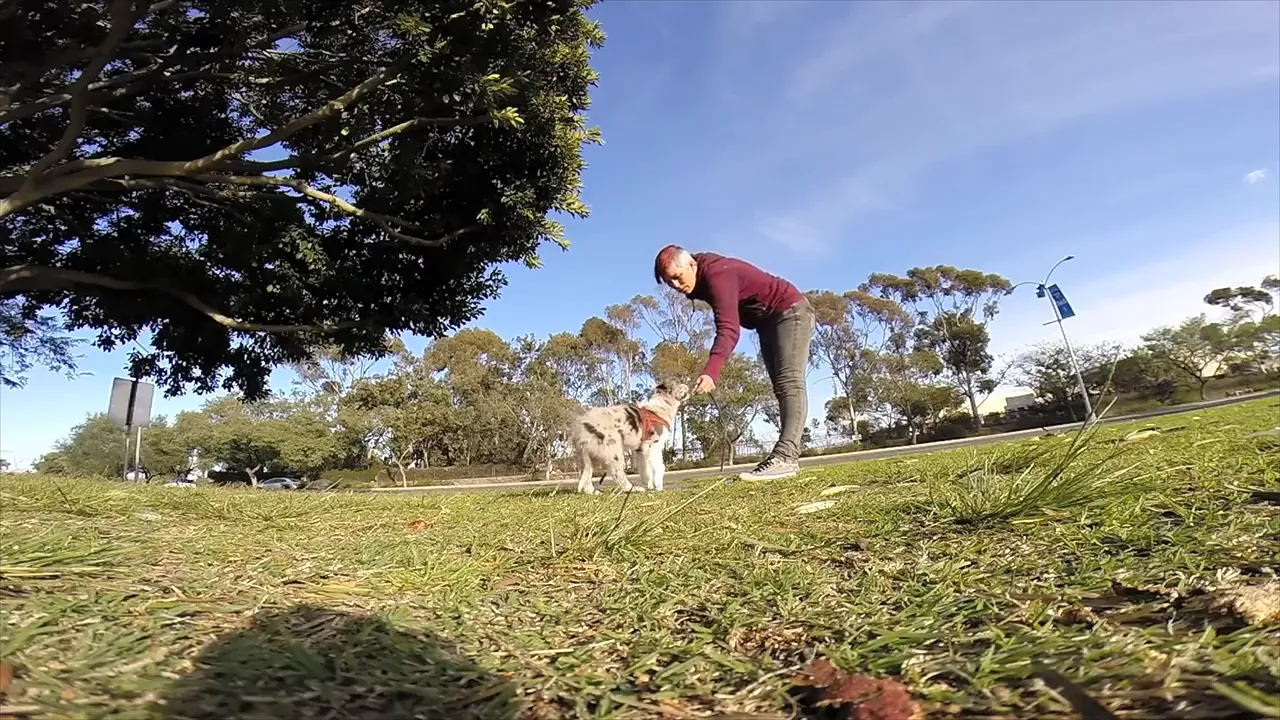
Look for flexibility in the dog’s attention. Can they notice something else? Can they disengage? Can they calmly search for food? Those observations tell you more than the fact that food is present in the session.
If the dog cannot do those things, break the situation down further rather than expecting the calming effect of food to overcome the intensity of the trigger.
Dramatic Behavior Does Not Always Mean Slower Progress
Some dogs who show very extreme chasing behavior are not the hardest dogs to train. I think about three separate dimensions:
- How extreme the behavior looks: the amount of visible activity the dog is showing.
- How aroused the dog is: their level of internal excitement, which is not always obvious from the amount of movement.
- How quickly training progresses: how readily the dog’s response changes over time.
A dog can show a lot of behavior without being as aroused as another dog who does very little. A quieter-looking dog is not necessarily finding the situation easier.
Progress also depends on genetics, previous experiences, setbacks, and how often the dog rehearses the behavior between training sessions. The appearance of the initial reaction alone does not tell us how long the work will take.
Wish’s Response to Cars
Wish was intensely interested in chasing cars from her very first experience of them. Yet it took only three training sessions for her to completely ignore them, and she continued ignoring cars over the following ten years.
During those sessions, I used slow, calm treat deliveries, a calm voice, and sometimes calm touch and massage. I believe the work I had already done to make food calming was an important part of her progress.
At the same time, I was developing her interest in toys, but that happened separately, in a completely different situation with no cars present. I was not using exciting toy play as the consequence of seeing traffic.
Protect Progress Between Training Sessions
Ideally, the dog does not encounter the things they react to outside the planned training setups. Otherwise, you can make progress in a carefully arranged session and then lose ground when the dog repeatedly rehearses chasing or reacting afterward.
I know this can be difficult. If you live in an apartment and have to pass traffic just to take your dog out to toilet, avoiding exposure may be a real challenge.
In those circumstances, I suggest making this work a high priority once you begin. The aim is to avoid a pattern of doing a little training, having repeated setbacks, and then trying to rebuild the same progress.
Start Proactively With a Herding Breed Puppy
You do not need to wait for a puppy to develop an established chasing habit. When a herding breed puppy first notices cars, bicycles, motorcycles, skateboards, running animals, or flying birds, you can begin reinforcing calm observation.
Use a calm verbal marker and deliver the treat slowly. Place the food so that the puppy turns away from the moving thing to eat it.
At first, you are reinforcing looking without doing anything. Over time, the goal is for those ordinary movements to become so unimportant that the dog no longer pays attention to them.
Being bred to herd does not mean every moving thing must become a herding target. Think of a dog working sheep: a bird passing overhead need not have any relevance to the task. We can help our dogs learn that many things in their environment have no particular significance.
Separately, we can build interest in something we control, such as a toy. My dogs are very interested in herding Frisbees. That interest can be developed without making cars or wildlife the signal for an exciting game.
Build Toward Real-Life Situations Gradually
The same general approach applies beyond cars. For more specific examples, I have tutorials on excitement around vacuums and brooms, chasing skateboards, and chasing wildlife in part one and part two.
Whatever the trigger, the foundation remains the same: establish calm reinforcement, arrange an easy version of the situation, and build gradually. Being near a freeway or having a single car approach on a country road may be a later challenge, not the place to start.
The goal is not simply to prevent a chase in one moment. It is to help the dog reach the point where the movement no longer feels important, just like leaves blowing in the trees.


