If your dog was walking quite nicely on leash and has suddenly started pulling again, I suggest looking at two things: how your dog feels in the environment, and what your dog has learned to do when the leash becomes tight.
Perhaps your dog walks beautifully near home but pulls as soon as you arrive somewhere exciting. Or perhaps pulling has crept back in because following your dog to an interesting smell occasionally reinforced it. Before long, you’re feeling frustrated, and your dog is practicing more of the behavior you don’t want.
The solution is to address both the reason for the pulling and the skill your dog needs instead. These two exercises work together: settling in new places helps your dog feel calmer, while the leash pressure game teaches your dog to reconnect with you when they reach the end of the leash.
Key Takeaways
- Address fear or overexcitement alongside loose leash walking skills when pulling returns.
- Practice settling at home before bringing a familiar mat or crate into new environments.
- Teach light leash pressure as a cue to turn toward you, without jerking.
- Use short refresher sessions and manageable distractions to rebuild connection before expecting changes on walks.
Table of Contents
- First, Check Whether Your Dog Is Worried or Overexcited
- Exercise 1: Teach Your Dog to Be Calm and Listen in New Places
- Exercise 2: Refresh the Leash Pressure Game
- How Much Practice Does Your Dog Need?
- Troubleshooting: What If Your Dog Keeps Pulling?
- Bring the Two Exercises Back Into Your Walks
First, Check Whether Your Dog Is Worried or Overexcited
When a dog starts pulling again, my first question is whether they are scared or overexcited. If either is contributing, loose leash walking practice alone doesn’t address the whole problem.
Heading straight into a long walk can mean your dog spends the entire outing pulling, feeling stressed, and struggling to respond to you. Repeating that experience can establish pulling as the new habit in that location. It also doesn’t teach your dog how to feel calmer there.
Instead, make the outing easier. Start by relaxing near your car, on a familiar mat, or in a familiar crate. Once your dog is comfortable, take little trips away from that resting place and return to settle again.
Exercise 1: Teach Your Dog to Be Calm and Listen in New Places
Build the settling behavior at home first
A mat or crate is useful because you can bring a familiar settling routine into a new environment. But the important part is the training you do before you get there.
Reinforce your puppy or adult dog for relaxing in easy, nondistracting places first:
- Inside your home.
- In your yard.
- In a crate inside a parked car, if that will be part of your outings.
I worked very consistently on settling in a crate with my puppy Epic before bringing that exercise to new locations. For a larger dog, a mat can be more convenient. Another option is to park somewhere suitable, open the rear door, and reinforce settling while your dog remains in their crate inside the car.
Simply bringing a crate or mat doesn’t mean your dog will know to relax. Without that foundation, the new situation may still be stressful.
Think of it like teaching a sit. You would normally practice in your kitchen or living room before expecting it somewhere distracting. Settling deserves the same preparation. My calm settle tutorial provides more detail on that foundation.
Choose a location that suits your individual dog
The best starting place isn’t necessarily the busiest place your dog can tolerate. Choose somewhere you think your dog can succeed.
For a dog who finds crowds overwhelming, an empty baseball field might be a good first step. Later, you could visit a quiet location during the middle of the day, when fewer people are around.
However, completely empty places aren’t always easier. Some dogs, including some herding dogs, find it startling when nothing is happening and then a person or dog suddenly appears.
For those dogs, a location with a predictable flow of distant activity may work better. You might settle on grass overlooking a path, far enough away that your dog can calmly observe people moving back and forth. Adjust the distance to your dog rather than expecting every dog to settle beside the same pathway.
Physical comfort matters, too. Epic was shivering during one chilly practice session, although she had been much more comfortable doing the exercise in sunshine. For her, I would choose a warmer time or use a sweater rather than expect her to relax while cold.
Reinforce going to the mat, then reinforce genuine relaxation
When you first begin, your dog may lie on the mat and stare up at you because you have just given them food. That’s a perfectly reasonable starting point.
Give your dog a head start by reinforcing the choice to go to the mat and lie down. A couple of treats can help make that familiar behavior easy in the new place.
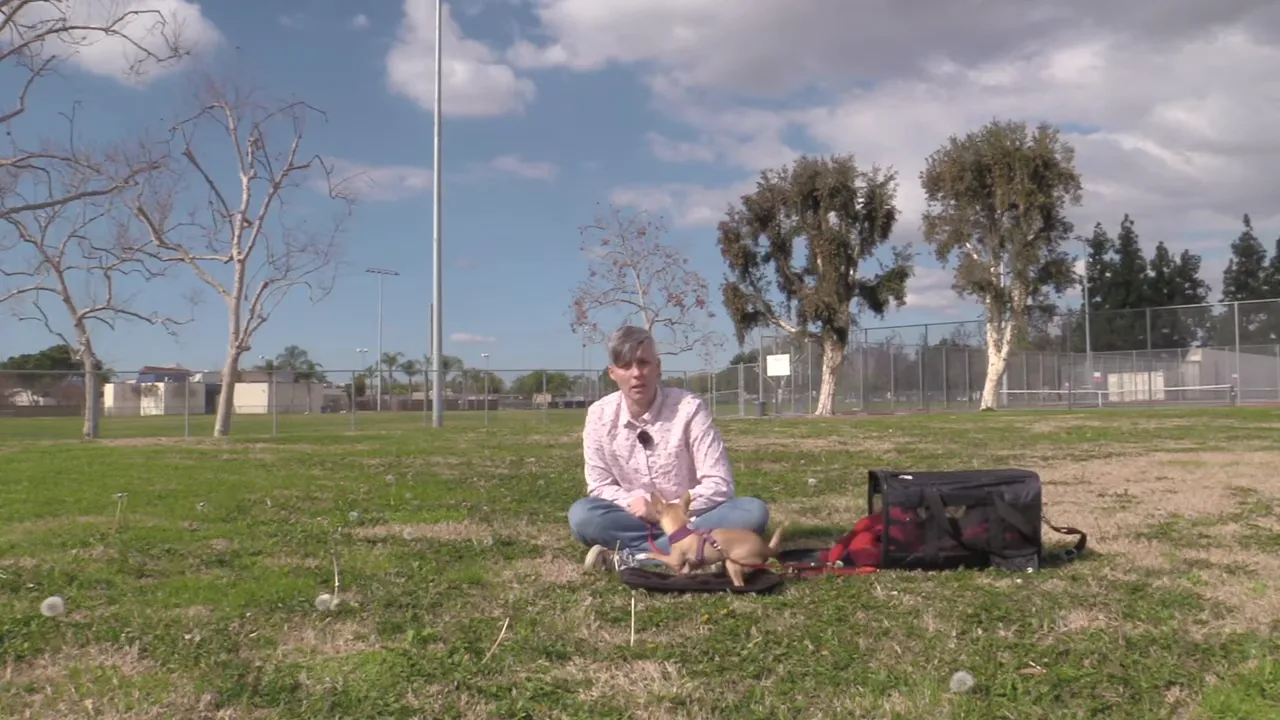
As your dog becomes comfortable, change what you reinforce. Rather than continuously feeding for staring at your hands or treats, notice the moments when your dog casually looks around while remaining settled.
At those moments, you can:
- Use a calm marker, then deliver a treat.
- Simply place a treat calmly between your dog’s front feet.
A marker is a familiar sound or word that identifies the behavior you’re reinforcing. Keep the delivery calm so the exercise continues to support settling.
The goal is not a dog who lies down only while concentrating on food. You’re reinforcing being comfortable on the mat while noticing the surroundings. For example, I reinforced Epic for calmly observing another dog passing, and then a skateboarder.
If your dog won’t take treats, don’t push the food at them
If your dog isn’t interested in food, refrain from repeatedly putting treats in their face or trying to persuade them to eat.
You can place a few treats on the mat or in the crate, just as you do at home, and keep the available leash area limited. Your dog may begin investigating and eating them as they feel calmer. Choosing to eat can be a useful sign that they are becoming more comfortable.
If your dog is really struggling, whining, or appearing stressed, make the setup easier rather than waiting them out. Practice at home, in the yard, in front of your house, or with the familiar crate in the car. The exercise should begin somewhere your dog can succeed.
Add short adventures away from the mat
Once your dog can settle comfortably, take a little adventure away from the mat and then return for another settling break.
Those short outings can include:
- A calm sniffing walk to investigate the environment.
- A little loose leash walking practice.
- Easy attention exercises your dog already knows well.
- Other familiar, strongly reinforced behaviors.
I don’t suggest introducing something new or making an existing behavior harder in a new environment. Ask for skills your dog already does well. Recalls can be useful, but if recalls are exciting for your dog and your immediate goal is calmness, choose a quieter exercise.
You can use a familiar release cue to leave the mat, then invite exploration with a cue such as “go sniff” and a pointing gesture.
Adjust the reinforcement to your dog. If your dog is so focused on you and the treats that they don’t investigate, mark and reinforce sniffing. If sniffing is already highly reinforcing, reward coming away from a smell and reconnecting when you give your walking cue.
Exercise 2: Refresh the Leash Pressure Game
Even when you’re addressing excitement or fear, your dog still needs to know what to do when they feel pressure on the leash.
The leash pressure game teaches a simple response: when the leash becomes tight, turn toward your person and move closer to loosen it.
This is not about jerking your dog or using the leash to intimidate them. Through small, carefully reinforced steps, light leash pressure can become a familiar cue to move with you rather than a frustrating surprise. This reward-based approach is consistent with the American Veterinary Society of Animal Behavior’s humane training guidance.
Practice four foundation skills first
Before introducing this game to a puppy, build a history of reinforcement for moving toward you and moving with you. I recommend these four foundations:
- The attention game, so your puppy has practice reconnecting with you.
- Recall, so moving toward you is a familiar, reinforced behavior.
- Standing and walking beside you, so being near you has value.
- Direction changes, so your puppy has practice following your movement.
These skills make choosing to move with you much easier once you introduce leash pressure. During an early park outing with my puppy, I first allowed some exploring and sniffing, then spent just one to two minutes reinforcing attention, position at my side, and direction changes.
Step 1: Introduce light pressure with a treat lure
Begin somewhere easy, such as your home or yard. Add light pressure to the leash while using a treat lure to guide your dog forward, then feed the treat.
The purpose is to introduce the sensation gradually so it isn’t a sudden surprise.
I suggest attaching the leash to a harness for this game, as well as for walks. If you intend to use a front attachment, practice with that attachment as well as the back attachment so your dog experiences the setup you’ll actually use.
Keep an eye on your puppy’s body language, including their tail. It should remain in a natural position. If your puppy begins tucking their tail, put this game aside for now and return to attention, recall, and handling exercises.
Step 2: Help your dog turn away from a distraction
Place a manageable distraction on the ground that interests your dog enough to move toward it and reach the end of the leash.
Use your familiar attention sound or a treat lure to help your dog turn around and come back to you. Reinforce that return.
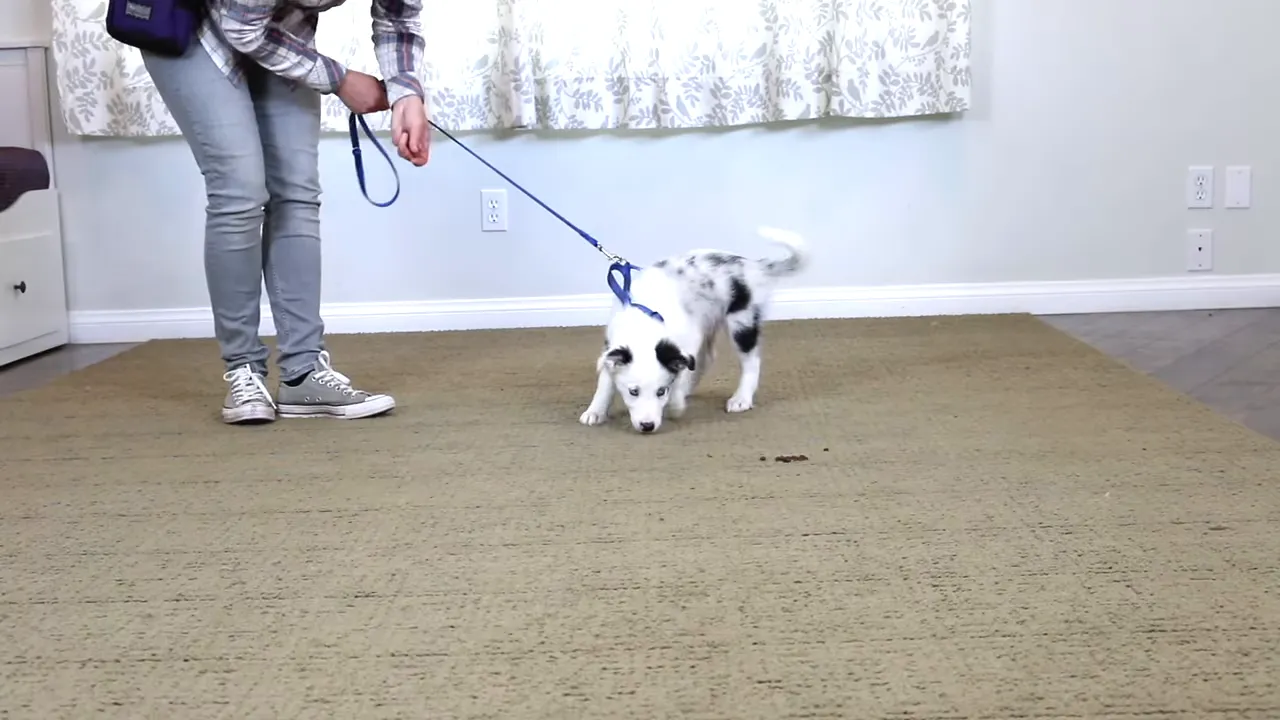
If your dog cannot turn away, change the setup:
- Increase the distance. A helper can place the distraction while you and your dog remain farther away.
- Make the distraction less valuable. Use a lower-value food on the ground and a higher-value treat to reinforce returning to you.
The point is to give your dog a successful experience, not to test how long they will pull toward something irresistible.
Step 3: Let light leash pressure become the cue
With the distraction in place, allow your dog to reach the end of the leash. Then move in the opposite direction without jerking.
Mark the moment your dog turns toward you, and feed close to your body. This placement encourages your dog to come all the way back rather than turning briefly and remaining at the end of the leash.
If your dog doesn’t turn toward you within about two seconds, help with your attention sound or treat lure. Don’t keep increasing pressure or wait for a struggle.
Once your dog returns, mark and reinforce several times for remaining beside you or in front of you before repeating. Staying connected is an important part of the exercise, not just the turn itself.
If your puppy sits or lies down instead of moving toward you, return to using the treat lure to clarify the response.
Keep your leash movement steady. You can hold your leash hand against your body and move your body, rather than making a sudden pulling motion with your arm. Also check behind you before backing up so you don’t trip over something.
Step 4: Practice with different distractions and situations
Once your dog understands the game in an easy setting, gradually practice around different things they want to investigate:
- Different foods.
- Toys.
- People.
- Dogs.
- Interesting sniffing spots, such as a fire hydrant.
This helps your dog generalize the skill. The lesson is that moving with you and keeping a loose leash is how to approach things they want, rather than pulling you toward them.
If your dog cannot turn away from a particular distraction, it is too difficult at that moment. Move farther away or make it less exciting.
How Much Practice Does Your Dog Need?
Think in terms of short training sessions spread across a few weeks, not one attempt during a difficult walk.
For a dog who has started pulling again, I recommend at least 10 to 12 brief refresher sessions over two to three weeks. Those sessions can be a minute or less. When first teaching a new puppy or dog, sessions of one to two minutes, practiced 10 to 12 times during the first few weeks, are a useful starting point.
Start at home or in your yard, where reconnecting is easy, then bring the skill back into walks. Give the conditioning time to build rather than expecting one session to immediately change your dog’s behavior everywhere.
Troubleshooting: What If Your Dog Keeps Pulling?
If your dog stops trying to reach the distraction and chooses to stay with you, that’s a good thing. You don’t need to keep encouraging pulling just to practice the turn.
If your dog repeatedly returns to you and immediately launches toward the distraction again, consider three possibilities:
- The distraction is too exciting.
- You are practicing too close to it.
- You need to spend more time reinforcing your dog for staying with you after returning.
And if your dog is worried or overexcited, return to the settling work. Knowing the leash pressure game doesn’t remove the need to help your dog feel comfortable in the environment.
Bring the Two Exercises Back Into Your Walks
After your dog has learned the leash pressure response, you can use it during everyday walks. If the leash becomes tight, gently back up until your dog moves with you and the leash is loose. Pause long enough to reconnect before walking forward again.
At a new location, begin with a familiar settling routine instead of immediately setting off on a long walk. Alternate short, manageable periods of exploration or easy training with opportunities to relax.
The aim is more than a slack leash for a moment. You’re helping your dog feel calmer, understand what leash pressure means, and find it worthwhile to stay connected with you. If pulling starts creeping back in, return to those easy, reinforced foundations.


